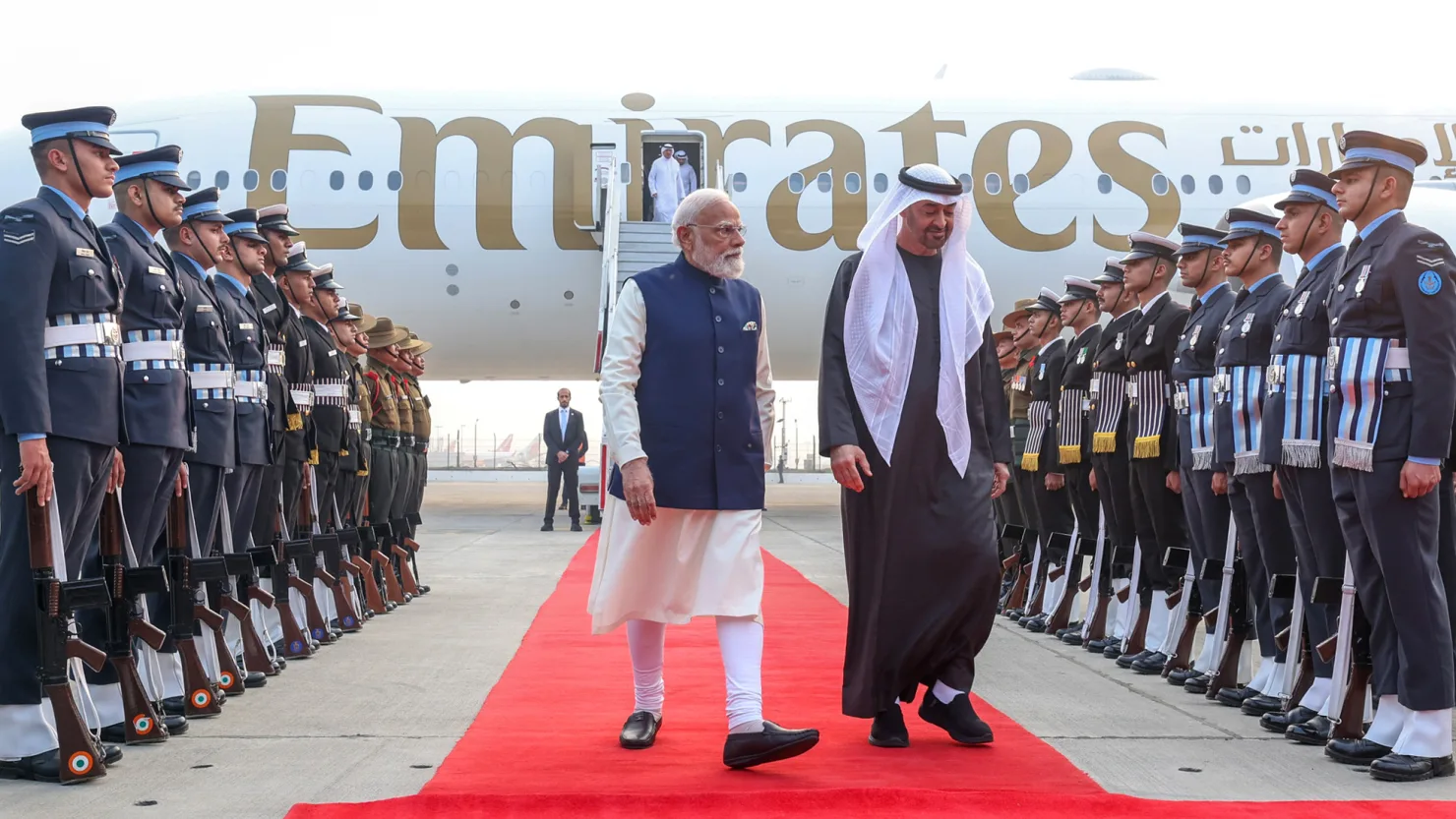
India has taken a major step to strengthen its energy security and global trade partnerships by signing a long-term liquefied natural gas agreement with the United Arab Emirates. The deal, worth up to $3 billion, comes as India looks to diversify its trade relationships while negotiations with the United States remain unresolved.
The agreement was announced following high-level talks between Indian Prime Minister Narendra Modi and UAE President Sheikh Mohamed bin Zayed Al Nahyan in New Delhi. Beyond energy, both nations also committed to doubling their bilateral trade to $200 billion by 2032, signaling a deepening strategic partnership.
A 10-Year LNG Supply Agreement
ADNOC to Supply LNG to India Starting 2028
Under the new deal, Abu Dhabi National Oil Company, the UAE’s state-owned energy giant, will supply liquefied natural gas to India’s Hindustan Petroleum Corporation Limited. The supply will run for 10 years, beginning in 2028.
The agreement allows for LNG deliveries worth up to $3 billion over the contract period, helping India secure a stable and long-term source of cleaner fuel as its energy demand continues to rise.
Strengthening Energy Security
India is one of the world’s fastest-growing energy consumers, driven by population growth, industrial expansion, and urbanization. Natural gas plays a critical role in India’s transition toward cleaner energy sources, especially as it seeks to reduce reliance on coal and oil.
By locking in LNG supplies years in advance, India reduces exposure to volatile global energy prices and supply disruptions.
Trade Ambitions: Targeting $200 Billion by 2032
Doubling Bilateral Trade
India and the UAE currently enjoy strong trade ties, with the Gulf nation serving as one of India’s most important partners in the Middle East. The new goal to double bilateral trade to $200 billion by 2032 reflects the growing economic integration between the two countries.
Trade between India and the UAE spans energy, infrastructure, manufacturing, technology, agriculture, and financial services. Both governments see significant untapped potential across these sectors.
A Broader Strategic Partnership
The relationship between India and the UAE has evolved beyond trade into a broader strategic partnership. Cooperation now includes defense, digital infrastructure, renewable energy, food security, and space technology.
The LNG deal is seen as a cornerstone of this expanding relationship, reinforcing trust and long-term cooperation between the two countries.
High-Level Talks Drive the Agreement
A Fast-Paced Diplomatic Meeting
The LNG agreement was finalized during a whirlwind three-hour meeting between Prime Minister Modi and President Sheikh Mohamed in New Delhi. Despite the short duration, the talks were packed with major announcements and strategic commitments.
State-owned companies from both countries signed the agreement during the visit, highlighting how quickly political alignment translated into concrete economic outcomes.
Leadership-Level Momentum
The personal rapport between the two leaders has played a key role in accelerating bilateral cooperation. Over recent years, India and the UAE have fast-tracked agreements that might otherwise have taken much longer to conclude.
This latest deal reflects that momentum and mutual confidence.
Why India Is Diversifying Its Trade Partners
U.S. Trade Deal Remains Uncertain
India’s push to strengthen ties with the UAE comes as negotiations with the United States, its largest trading partner, remain uncertain. Recent U.S. tariffs on Indian exports have added strain to the relationship and increased pressure on India to reduce overdependence on any single market.
With no immediate breakthrough in sight, India is accelerating efforts to expand trade with other major economies.
New Agreements With Multiple Countries
In recent months, India has announced or advanced trade agreements with the United Kingdom, Oman, and New Zealand. These deals are part of a broader strategy to create a more balanced and resilient trade network.
The UAE, given its geographic location and economic influence, plays a central role in that strategy.
The UAE’s Growing Role in Asia
A Key Energy Supplier
For the UAE, the LNG deal strengthens its position as a reliable energy supplier to Asia, one of the world’s most important growth markets. As global energy flows shift eastward, long-term contracts with countries like India provide stability and predictable demand.
The agreement also supports the UAE’s goal of expanding its energy exports beyond crude oil.
Deepening Economic Influence
The UAE has been actively expanding its trade and investment ties across Asia. Partnerships with India allow it to diversify its economy while strengthening political and economic influence in the region.
The $200 billion trade target underscores how central India is to the UAE’s long-term economic vision.
What This Means for India’s Economy
Boost for Energy Planning
Securing long-term LNG supplies helps India plan its energy infrastructure more effectively. It provides certainty for investments in gas pipelines, terminals, and power generation facilities.
Stable energy supplies are essential for sustaining economic growth and supporting manufacturing and industrial expansion.
Supporting India’s Energy Transition
Natural gas is seen as a transition fuel in India’s move toward a lower-carbon economy. While renewable energy capacity continues to grow, gas helps bridge the gap by providing reliable power with lower emissions than coal.
The UAE deal fits neatly into India’s broader energy transition strategy.
A Signal to Global Markets
Confidence in Long-Term Cooperation
The agreement sends a strong signal to global markets about India’s ability to secure long-term energy partnerships despite geopolitical and trade uncertainties.
It also highlights the UAE’s willingness to commit capital and resources to long-term relationships rather than short-term transactions.
A Model for Future Deals
The structure of the LNG agreement could serve as a model for future energy deals between India and other suppliers. Long-term contracts provide stability for both buyers and sellers in an increasingly unpredictable global energy market.
The Bigger Picture
India’s $3 billion LNG agreement with the UAE is more than just an energy deal. It reflects a strategic shift toward diversified trade, stronger regional partnerships, and long-term economic planning.
As talks with the United States continue without resolution, India is clearly signaling that it will not wait on any single partner. Instead, it is building a wide network of alliances to support growth, energy security, and global influence.
With a bold $200 billion trade target set for 2032, the India-UAE partnership appears poised to play a major role in shaping economic ties between South Asia and the Middle East for years to come.