


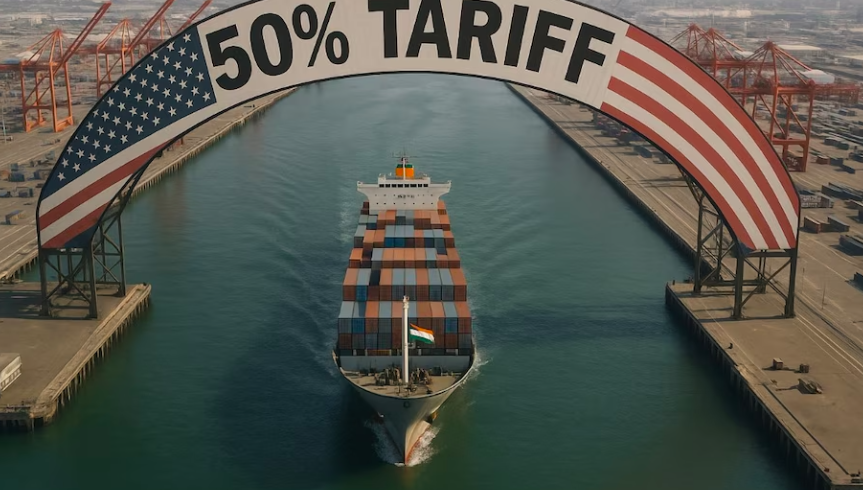
The Indian stock market was hit hard on Thursday when investors absorbed the news of a significant hike in US tariffs on imports from India. The BSE Sensex dropped 666.39 points, or 0.82 per cent, to 80,120.15, and the NSE Nifty dipped 194.15 points, or 0.79 per cent, to 24,517.90. While the short-term sell-off was seen, market commentators are cautiously optimistic and saw the imposition of tariffs as a short-term setback and not a structural risk.
The US has put an extra 25 per cent duty on Indian products, causing trade tensions between the two nations. This can cause a 50–80 basis point hit on India’s GDP growth rate primarily because of reduced export demand and possible spillovers into jobs and investment. However, experts note that the initial effect in the next three to six months could be restrained due to logistical issues, supply chain restrictions, and delays in paperwork.India has not so far taken any retaliatory steps, instead opting to maintain space for negotiations with America, notes Radhika Rao, an economist at DBS Bank. Principal sectors such as pharmaceuticals, semiconductors, and electronics are currently excluded from the purview of Section 232 tariffs. Other sectors have differentiated rates applied to them—such as steel and aluminium, which are subject to 50 per cent tariffs, and cars and automobile parts, which are at 25 per cent, effectively creating a rate of about 33–35 per cent.
Among the most vulnerable industries are textiles and gems & jewellery, which are under greater threat from intra-regional competition. Rao pointed out, “With the substitution effect of textiles higher than that of gems & jewellery, with the higher skill-based work involved, textiles are likely to bear the brunt of these tariffs.” This points out that though some industries might be hit hard, the overall market should be able to withstand the effect quite well.
Nomura has predicted that tit-for-tat tariffs will probably stay at 25 per cent during FY26, with a chance of phasing out the 25 per cent penalty post-November. The brokerage has recently downgraded its FY26 GDP growth to 6 per cent from 6.2 per cent based on softer exports, softer labor market activity, and investment, but maintained the CPI inflation forecast of 2.7 per cent. There are analysts who view potential disinflation threats emerging from GST realignments and soft demand.
Equity Market Impact
Equity markets are expected to come under some short-term pressure, mainly on account of apprehensions about foreign portfolio investment (FPI) outflows. Antique Stock Broking observed that US-linked FPIs hold 40 per cent of India’s assets under custody, so higher tariffs may lead to risk aversion by foreign investors. But domestic mutual funds are still supporting the market through sustained systematic investment plan (SIP) inflows.
VK Vijayakumar, Chief Investment Strategist at Geojit Investments, pointed out that although the 50 per cent tariff may have a bearing on sentiment in the short term, panic is improbable. He referred to US Treasury Secretary Scott Bessant’s comment that “India and the US will come together” as being reflective of resolution. Vijayakumar further added that the immediate issue for the market is high valuations and low earnings growth, not the tariff.
Analysts recommend that investors can gain by turning their attention towards relatively valued large-cap stocks focused on domestic consumption instead of overvalued export-dependent small-caps. Antique’s study concurs with this argument, showing that the first three to six months of the tariff regime are likely to have little effect, except perhaps for textile firms that are the only sector likely to feel meaningful repercussions.
Sensex and Nifty Technical Outlook
Technically, the indices have indicated stress. Vaishali Parekh, PL Capital’s Vice President of Technical Research, pointed out that Nifty printed a bearish candle on the daily chart and broke below the 50-day exponential moving average (EMA) near 24,850. She said the market is following global events and news on tariffs to determine its next move. In Parekh’s view, the key support for Nifty is at the level of 24,500 and a determined break below 25,000 would be required to regain bullishness.
For the Sensex, Parekh observed that the index has fallen to selling pressure at the 100-EMA level of 80,826. If it holds below the 80,300 zone, a further fall towards 79,700 can be expected. On the higher side, crossing 81,500 would be needed to indicate fresh positive momentum. These technical markers indicate that although the immediate market situation is guarded, there are clear-cut support and resistance levels which investors can monitor to manage volatility.
Looking Forward
While short-term strain from increased US tariffs poses pressures, market experts hold a positive expectation for the overall Indian market with caution. The anticipation of short-term nature of tariffs, ongoing domestic investment inflows, and sound fundamentals in non-export domains are mainstay supports. While export-dependent sectors such as textiles might suffer, consumption-based domestic-focused sectors and large-cap stocks would be good investment destinations to pursue.
On the whole, although the 50 per cent US tariffs have injected an element of uncertainty, most market observers expect the effect on India’s financial markets to be bearable. Equity investors are urged to remain concentrated on quality large-cap stocks, keep watching global events, and be patient as diplomatic talks between India and the US go on.
The key takeaway is that, although the tariff news initially triggered market losses, the Indian economy’s diversified structure and resilient domestic demand are expected to mitigate longer-term repercussions, allowing the market to recover once temporary disruptions pass.


Leave a comment


