


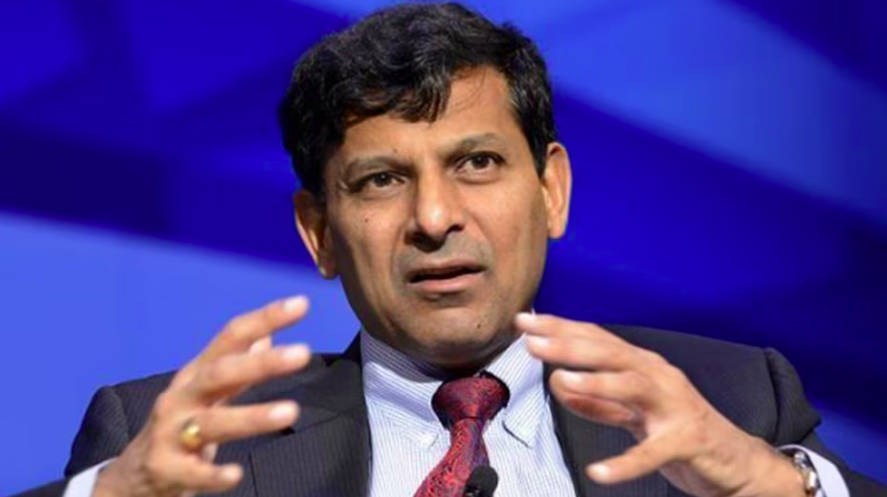
Former Reserve Bank of India Governor Raghuram Rajan has cautioned that the recent 50 per cent tariffs slapped by US President Donald Trump on Indian products should be a wake-up call for India to diversify its trade and investment links. In an elaborate interview with India Today TV, Rajan called the action a “wake-up call” and noted that trade, finance, and investment have become increasingly tools of geopolitical leverage.
“This is a wake-up call. Let us not become dependent on any single country to a large extent,” Rajan said. “Let us look east, to Europe, to Africa, and continue with the US, but unleash reforms that will help us achieve the 8–8.5% growth needed to employ our youth.”
Rajan’s remarks come against the background of escalating tensions in Indian-American trade relations in the wake of punitive tariffs by the Trump administration. The tariffs, he added, are not merely an economic weapon but a calculated exercise of power, utilized to impose foreign policy goals. He cautioned that India has to meticulously reevaluate its policies, especially the imports of Russian oil, and analyze who wins and loses out of such trade deals.
Refiners are earning excess profits, but the exporters are paying the price in the form of tariffs,” Rajan said. “If the gain is not significant, perhaps we need to think about whether we should be going on with these purchases.”
He highlighted the need for diversification, both in exports and imports. “We cannot be dependent on someone to a large extent. Trade has been weaponised. Investment has been weaponised. Finance has been weaponised.”. We need to diversify our export markets and sources of supply,” Rajan stated. He also emphasized the need for strategic interaction with larger powers such as China, Japan, and the US, without India becoming dependent upon a particular country too much. “Have alternatives, including being self-reliant where feasible,” he suggested.
The previous RBI governor focused on the direct and concrete effects of the tariffs on small and medium-sized Indian exporters. Textiles and shrimp cultivation are especially exposed, with companies suffering from huge price markups because of the tariffs. “It is also bad for the US consumer, who will now purchase commodities at a 50 per cent markup,” Rajan explained, adding that the effects are not uni-directional but are felt by both exporters and buyers.
Rajan credited the US tariffs to three factors. One is the idea, held by some circles of the Trump administration, that trade deficits are a sign of exploitation by other nations. Two is the idea that tariffs raise money cheaply, essentially passing the economic burden to foreign partners. Three, and perhaps most significantly, tariffs are more and more being viewed as punitive tools in the arena of foreign policy.
“It is really an exercise in power. It’s not a matter of fairness,” he said, pointing to the strategic and not economic character of the tariffs.
The economist also responded to recent remarks by Trump’s former trade adviser Peter Navarro accusing India of being a “laundromat” for Russia and claiming India had gained from the war in Ukraine. Rajan termed these remarks as politically motivated, pointing out that Navarro’s claims would have been sanctioned at the highest levels of the US government. “What evidently appears to have transpired is, somewhere along the line, the president has concluded that India is a nation that is not playing by the rules that he alleges and must be singled out. Navarro would not opine in the Financial Times without approval,” Rajan commented.
Navarro had escalated his rhetoric by dubbing the Ukraine conflict as “Modi’s war,” a statement that Rajan implies is more reflective of political positioning than an accurate assessment of India’s foreign policy.
For India, the main lesson from these events, in Rajan’s view, is that it needs to recast its trade strategy with a sense of urgency. Geographical and sectoral diversification is no longer a choice but a requirement to offset the risks stemming from volatile global economic policies. By lessening dependency on one nation and encouraging alternative trade alliances, India can improve protection against the disruptive impact of unilateral actions such as the Trump tariffs.
Rajan also underscored the importance of domestic reforms in strengthening India’s resilience in the economic sphere. Recording 8–8.5 per cent growth rates consistently, he opined, is important not only from the point of view of generating employment but also to build a cushion for defending against the vagaries of external shocks. Structural reforms, expenditure on infrastructure, and ease of doing business were all mentioned as being integral parts of a strategy that could wean the country from depending on international markets even while building internal capabilities.
Although the immediate worry is the economic burden of the tariffs on small exporters and certain industries, Rajan’s larger message is strategic. India needs to develop a multi-directional trade and investment strategy, having engagement with the US, Europe, China, and other major players on one hand, while seeking self-reliance where possible on the other, without any one external partner being able to hold disproportionate sway over India’s economic stability.
By way of conclusion, the 50 per cent US tariffs are not merely a trade barrier—instead, they embody the growing weaponization of economic global instruments for political objectives. For India, the issue is one of how it must maneuver in this complicated setting through diversifying trade, rebalancing strategic imports, and speeding domestic reforms. In the opinion of Rajan, such controls are not only necessary to protect the interests of Indian consumers and businesses but also to pursue economic sovereignty at a time when finance, trade, and investment have become tools of geopolitical influence.
By adopting this path, India can turn a “wake-up call” into a chance—making its economic resilience stronger, strengthening its global partnerships, and creating a more solid foundation for long-term growth in the coming years.


Leave a comment


