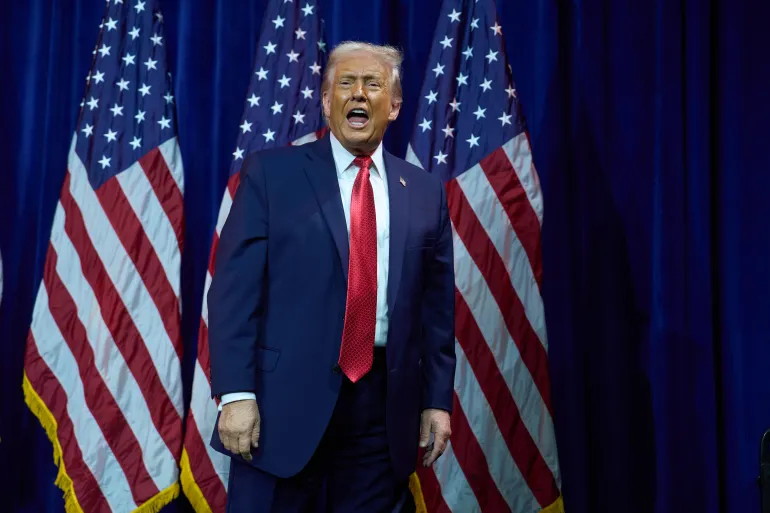
U.S. President Donald Trump said that Venezuela’s interim authorities will turn over between 30 million and 50 million barrels of oil to the United States, marking a dramatic development in the aftermath of Washington’s recent intervention in the South American nation. The announcement immediately rippled through global energy markets, pushing U.S. crude prices lower and raising fresh geopolitical and legal questions about the future of Venezuela’s oil sector.
In a social media post on Tuesday evening, Trump said the oil would be sold at prevailing market prices, but that the proceeds would be overseen directly by him as president. According to Trump, the funds would be used “to benefit the people of Venezuela and the United States,” positioning the move as both an economic and political intervention.
“I have asked Energy Secretary Chris Wright to execute this plan immediately,” Trump wrote, adding that the oil would be transported using storage ships and unloaded directly at U.S. ports. He described the crude as “high quality” and “sanctioned,” suggesting it would face no regulatory hurdles under existing U.S. restrictions.
Immediate Market Reaction
The announcement had an instant impact on oil markets. U.S. crude futures fell around 1.3% following Trump’s statement, dropping to approximately $56.39 per barrel. Traders appeared to react to the prospect of additional supply entering the U.S. market at a time when prices were already under pressure due to global demand uncertainty and rising inventories.
While the volume—30 to 50 million barrels—is relatively modest in the context of global oil consumption, the political implications of the transfer weighed heavily on sentiment. Analysts noted that even symbolic shifts in supply can influence short-term pricing, especially when tied to major geopolitical events.
Context: Venezuela’s Political Upheaval
Trump’s announcement comes just days after U.S. forces captured Venezuelan leader Nicolás Maduro and his wife in Caracas and transported them to New York, where they face federal charges linked to an alleged drug-trafficking conspiracy. The move marked one of the most aggressive U.S. actions in Latin America in decades and has drawn sharp reactions from governments and international observers around the world.
Following Maduro’s ouster, interim authorities assumed control in Venezuela, with Washington signaling its intention to play a central role in shaping the country’s political and economic future. Oil, Venezuela’s most valuable natural resource and primary export, has quickly emerged as a focal point of this transition.
Venezuela holds some of the world’s largest proven oil reserves, but years of underinvestment, mismanagement, and sanctions have crippled production capacity. Infrastructure decay at state-owned oil company PDVSA has left refineries and export terminals operating far below their potential.
Control of Proceeds Raises Questions
One of the most controversial aspects of Trump’s statement was his claim that the proceeds from the oil sales would be “controlled by me.” While he framed this as a mechanism to ensure transparency and benefit for both nations, critics are likely to question the legality and governance of such an arrangement.
Traditionally, revenues from a country’s natural resources are controlled by its government or designated institutions. Trump’s assertion suggests an unprecedented level of U.S. oversight over Venezuelan oil income, raising questions about sovereignty, international law, and how funds would actually be distributed or monitored.
Trump did not provide details on how the money would be allocated, whether it would be placed in escrow, or how Venezuelan citizens would directly benefit. These unanswered questions are likely to become central to political and legal debates in the days ahead.
U.S. Oil Majors Eye Venezuela
Adding to the significance of the announcement, Trump is reportedly planning to meet representatives from major U.S. oil companies—including Chevron, ConocoPhillips, and Exxon Mobil—at the White House later this week. The discussions are expected to focus on potential investments in Venezuela’s oil sector.
For U.S. energy companies, Venezuela represents both opportunity and risk. The country’s vast reserves are attractive, but political instability, deteriorating infrastructure, and a history of expropriation have made large-scale investment difficult. Any renewed involvement would likely require significant capital, long-term guarantees, and a stable political framework.
If U.S. firms are encouraged to return, it could signal a broader strategy to reintegrate Venezuela into Western energy markets while reducing its dependence on non-Western partners.
Strategic Implications for Energy and Politics
The transfer of Venezuelan oil to the United States could have implications beyond immediate market movements. Strategically, it may strengthen U.S. energy security in the short term while reshaping power dynamics in the Western Hemisphere.
At the same time, the move could provoke backlash from countries that view U.S. actions in Venezuela as overreach. It may also complicate relationships with other major oil-producing nations, particularly if the U.S. is seen as leveraging political power to secure energy resources.
For Venezuela, the oil handover underscores how central its energy sector remains to any recovery plan. Whether this arrangement ultimately helps rebuild the country’s economy or deepens external dependence will depend on how revenues are managed and whether longer-term investments restore production capacity.
Uncertain Path Ahead
While Trump’s announcement was sweeping in scope, many practical details remain unclear. Questions linger over logistics, timelines, legal frameworks, and international responses. It is also uncertain how quickly Venezuela can deliver the stated volume of oil, given the current state of its production and export infrastructure.
What is clear is that oil has once again become a powerful geopolitical lever. Trump’s declaration places Venezuela’s most critical resource at the center of U.S. foreign policy, with potential consequences for energy markets, regional stability, and global diplomacy.
As events continue to unfold, investors, policymakers, and governments worldwide will be closely watching how this unprecedented plan is implemented—and whether it sets a new precedent for how natural resources are used in international power struggles.