Bitcoin (BTC-USD) has breached the coveted ceiling of $105,000 (£84,359) following the surprise decision by the U.S. Federal Reserve to maintain interest rates. The move aligns with an announcement made by Federal Reserve Chairman Jerome Powell where he confirmed the U.S. banks were now free to support the servicing of crypto clients—so long as they properly managed the associated risks. The decision has been significant enough to impact Bitcoin’s price, which rallied 3% to trade at just over $105,000 on Thursday after dipping to $101,800 on Wednesday. This is Bitcoin’s highest level in the past three days.
The Federal Reserve’s diktat on digital assets, especially Bitcoin, has created waves in both the crypto and traditional finance worlds. The last-ditch decision to permit U.S. banks to handle clients having accounts with cryptocurrencies marks a stark departure in the regulation process, presenting opportunities and challenges for the larger market. Let’s dive deeper into what exactly this announcement means for Bitcoin’s future price movement.
Fed Decision and How This Could Impact Bitcoin Price
On Wednesday, at a press conference following the post-Federal Open Market Committee meeting, Jerome Powell said that banks can offer services to the sector of crypto customers if they can understand and manage the risks involved. This is a clear indication of the Federal Reserve’s changing viewpoint over digital assets.
The chairman went on to emphasize that any bank under the Fed’s regulatory umbrella has a responsibility to its clients’ activities in crypto space to be “safe and sound.” For many years, crypto has been scrutinized by both regulators and mainstream financial institutions, but Powell’s comments may finally be signaling the tide is changing in favor of greater acceptance and integration of digital currencies into mainstream finance.

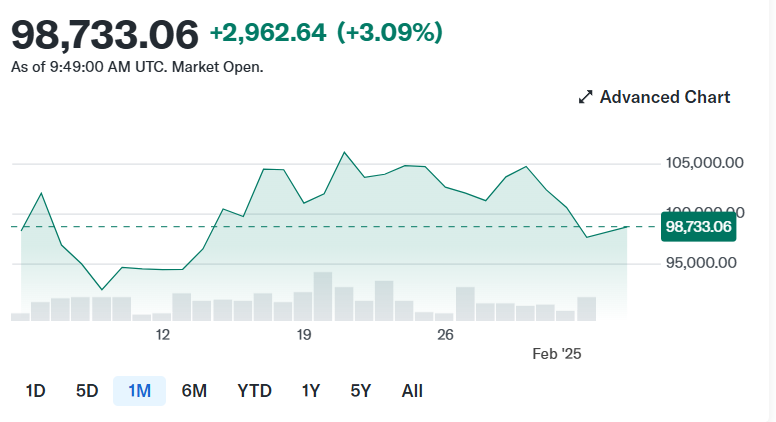
The price of bitcoin surged 3% to above $105,000 following the announcement, with the currency managing a spectacular turnaround after dropping as low as $101,800 the previous day. At current prices, it is about 4% off its all-time high of $109,241 reached before the inauguration of President Donald Trump on January 20.
This is a continuation of the momentum that has taken Bitcoin’s price higher, in part due to the Fed’s decision to leave interest rates alone and the greater market’s understanding of Bitcoin as a potential store of value. Ethereum (ETH-USD) also surged by 2.5% to $3,210, and Solana (SOL-USD) is up 3.7%, trading at $240. The upward price action across major cryptocurrencies has led analysts to speculate that the crypto market is on the threshold of a new bullish phase.
Federal Reserve’s Approach on Interest Rates
Traders were not surprised as the Federal Reserve maintained its benchmark interest rate unchanged in a range of 4.25% to 4.50%. In this regard, using the CME’s FedWatch tool, interest rate traders are now also forecasting an 82% chance that rates will be held steady through the next Federal Reserve meeting in March. This has caused a bit of certainty for investors, as reflected in Bitcoin’s price action.
The decision to hold off on another rate hike comes in the wake of a string of interest rate cuts made in 2024, which collectively reduced the federal funds rate by 100 basis points. According to Powell, the stance to hold rates steady was taken after considering the ease of the economy and continued pressure of inflation. While inflation has eased considerably from its 2022 peak of 9.1%, it remains at 2.9% annually, suggesting that further rate hikes could still be in the cards if inflation doesn’t continue to cool.
Indeed, the interest rate decisions have an impact on the cryptocurrency market in a very great way. Interest rates that rise make bonds and savings accounts seem more attractive for investors, leading to a drop in demand for riskier assets like Bitcoin. However, interest rates are at a steady position, and the inflation remains persisting, a situation that works well for Bitcoin, which many people view as a hedge against inflation.
The Role of Bitcoin in the Current Financial Landscape
The price rise of Bitcoin also mirrors larger economic trends. As the public is left to speculate about inflation and interest rates, many investors have flocked to Bitcoin and other cryptocurrencies as a store of value. Bitcoin, often termed “digital gold,” is viewed as a way to protect wealth against the effects of inflation and currency devaluation.
This is further bolstered by the Federal Reserve’s willingness to allow banks to serve crypto clients, which shows recognition of the increasing influence of digital assets in the global economy. As the U.S. government and central banks begin to include cryptocurrencies in the financial ecosystem, the case for Bitcoin and other digital currencies as legitimate financial instruments is gaining momentum.
Czech National Bank’s Proposal to Add Bitcoin to Reserves
Another significant development for the space of cryptocurrencies, Aleš Michl, who is the governor of the Czech National Bank, recently proposed the addition of Bitcoin to the central bank reserves in the country. This is bold for a central bank and goes to show that Bitcoin is finally being recognized by many as having potential as an asset class.
This proposal symbolizes a change in the thinking of national governments and financial houses towards embracing a digital asset as part of everyday transactions. Despite the fact that Bitcoin’s representation in a reserve of a national central bank still has not widely become the ‘norm’, yet this action would encourage other nation-states to implement Bitcoin into the reserve of theirs.
It is no longer only the individual investor or the institutional player. It now includes and is gaining acceptance from national governments. This trend portends that the integration of Bitcoin into the global financial system will continue on an upward trajectory during the next few years.

Future of Bitcoin
A very important question is in the minds of most investors concerning Bitcoin, which has seen the price go beyond the all-time high of $105,000. Even though Bitcoin, indeed, remains a volatile asset, this recent trajectory is actually a good sign about its long-term health. The kind words at the Fed regarding interest rates and digital assets, accompanied by institutional affirmation in the form of Bitcoin itself, could mean there’s a new bull run around the corner.
The price of Bitcoin could go higher if inflation is persistent and investors keep seeking refuge in digital assets. However, with any investment, there is a risk involved. The volatility of the crypto market, along with possible regulatory changes, can lead to price swings overnight.
While Bitcoin’s future remains uncertain as the world of cryptocurrency continues to evolve, the recent price movement and regulatory developments do suggest that the role of Bitcoin in the global financial system will only grow in importance.
FAQs: Bitcoin Price Soars Past $105,000
Why did Bitcoin’s price jump past $105,000?
Bitcoin’s price jumped past $105,000 after the Federal Reserve resolved to keep interest rates unchanged and let U.S. banks serve crypto customers. The same announcement was coupled by Jerome Powell’s statements that the banks need to handle the risks involved with the crypto customers and made the market sentiment positive around Bitcoin.
How does the Federal Reserve’s decision affect Bitcoin?
The Federal Reserve’s decision to keep interest rates unchanged helps provide stability to the financial markets, including Bitcoin. With inflation still persistent, many investors turn to Bitcoin as a hedge, which increases demand and drives up its price. Powell’s remarks about banks being able to serve crypto clients also signal a more favorable regulatory environment for digital assets.
What does it mean for the Czech National Bank to propose to add Bitcoin into reserves?
A proposal by the Czech National Bank to add Bitcoin to the nation’s reserves gives Bitcoin a kind of legitimacy into becoming a reserve asset. The adoption of it would encourage the other central banks to add Bitcoins to their own reserves, gradually integrating the digital asset into the global financial system.
What are the risks of investment in Bitcoin?
Bitcoin is still a volatile asset, and prices may fluctuate widely. More than that, potential regulatory changes and security risks such as hacking or fraud expose investors to certain risks. So, like all investments, investing in Bitcoin must be preceded by research and full understanding of risks.
What does the future of Bitcoin price action look like?
Bitcoin’s future price action is sensitive to various factors such as inflation, interest rates, regulatory development, and market sentiment. With persistent inflation and further institutional acceptance, Bitcoin might continue its rally. But then again, its volatility can result in large corrections. So investors need to be watchful and observe market trends closely.