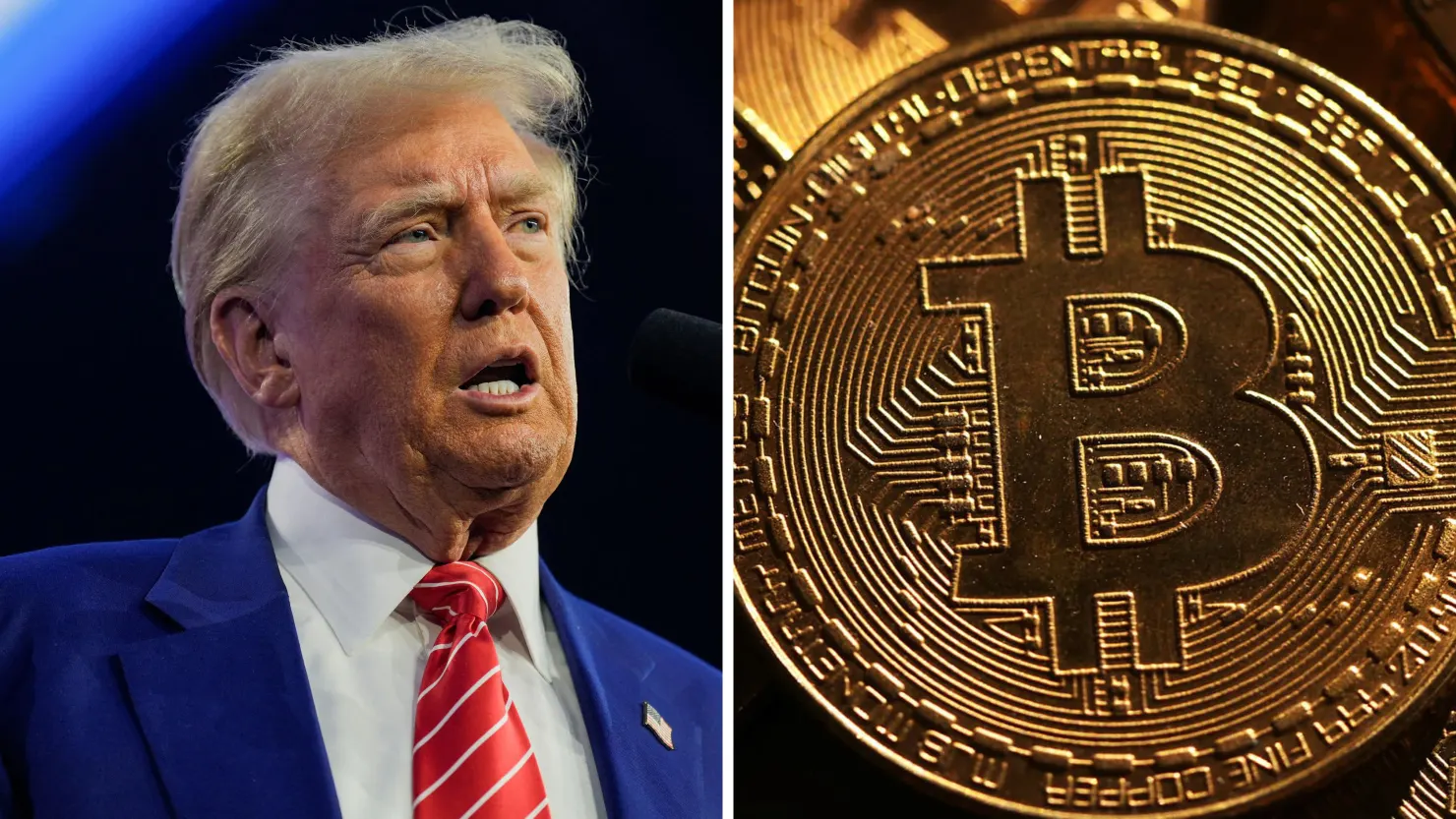
Bitcoin and the overall cryptocurrency market tumbled sharply on Sunday after President Donald Trump unveiled new tariffs for Canada, Mexico, and China. The shockwaves sent markets around the world into a selloff in risk assets, including digital currencies.
The Initial Market Response
Bitcoin fell 7% to $93,768.66, Coin Metrics reported, and the CoinDesk 20, a benchmark of the largest 20 digital assets by market capitalization, sank 19%. Ether, the second-largest cryptocurrency by market cap, plummeted 20%, touching its lowest since November.
Market volatility started late Saturday night after President Trump signed an executive order, imposing a 25% tariff on imports from Mexico and Canada, as well as a 10% tariff on Chinese goods. These tariffs are to come into effect on Tuesday and will affect $1.6 trillion in trade between the U.S. and the three affected countries.
Bitcoin as a Risk Asset
Bitcoin is often heralded as an inflation hedge or against economic uncertainty; however, it behaves similarly to a risky asset in its short-term trading pattern. During such periods, during market turbulence, Bitcoin trails more traditional equities and commodities on the downturn, only potentially coming back with some strength long-term.
Jeff Park, head of alpha strategies at Bitwise Asset Management, thinks that an extended tariff war may ultimately benefit Bitcoin by weakening the U.S. dollar and interest rates. He also recognizes that short-term volatility is inevitable.
Critical Support Levels and Market Sentiment
Technical analysts keep a close watch on the Bitcoin price level, which is critical support at the $90,000 mark. If it gets broken, one can expect Bitcoin to slide lower to $80,000 levels. Bitcoin stands at around 16% off its all-time high of $109,350.72 it achieved on 20 January, 2024.
Although the correction is steep, experienced crypto traders know that corrections of 30% or more are commonplace during bull markets. This makes the current downtrend uncomfortable for new investors but a familiar pattern for seasoned market participants.

The Role of Macroeconomic Factors in Bitcoin’s Decline
Apart from the immediate impact of Trump’s tariffs, several macroeconomic elements are influencing Bitcoin’s price action:
Rising Interest Rates: The Federal Reserve’s intention to keep higher interest rates has strengthened the U.S. dollar, which has a tendency to weigh down Bitcoin and other cryptocurrencies.
Regulatory Uncertainty: The U.S. Securities and Exchange Commission has continued its crackdown on crypto-related businesses, which creates uncertainty for institutional investors.
Market Liquidity: Geopolitical concerns continue to increase the volatility of stock markets. This pushes investors to draw liquidity out of speculative assets like cryptocurrencies, further reducing their portfolios’ risk profile.
How Traders React
When markets become unstable, the following tactics become commonplace as traders attempt to control risk while possibly gaining access to future opportunity:
Short Selling and Hedging
Professional traders are increasingly turning to derivatives markets to short Bitcoin and hedge their portfolios. The Chicago Mercantile Exchange (CME) has reported a spike in Bitcoin futures trading volumes as traders seek downside protection.
Buying the Dip
Contrarian investors view the correction as a buying opportunity, believing that Bitcoin’s long-term fundamentals remain strong. These investors are accumulating positions at lower prices, anticipating a rebound once market sentiment stabilizes.
Stablecoin Flight
A major part of the investors transferred their funds into stablecoins like Tether (USDT) and USD Coin (USDC) to maintain capital due to heightened volatility. This is a typical reaction during downturns in cryptocurrencies.
Possible Long-Term Fallout
Bitcoin: A Safe-Haven Asset
While short-term reactions were in the negative, in the long term, the safe haven role of Bitcoin is there. In the past, prolonged uncertainty over economies and sharp monetary policies have obligated investors to Bitcoin as a hedge against inflation and devaluation of fiat currencies.
Institutional Interest
Institutional investors are still interested in Bitcoin as a strategic asset despite the recent downturn. Large financial firms and hedge funds will return to the market once the price stabilizes.
Future Market Regulation
The trade war might speed up the regulatory development of cryptocurrencies. Governments worldwide may implement new policies to protect digital asset investors while maintaining economic stability.
Frequently Asked Questions (FAQs)
Why did Bitcoin drop after Trump announced tariffs?
Bitcoins fall, which was sparked by further marketplace uncertainty following news by Donald Trump of Cancelling new tariffs on Mexico, Canada, and China. As Bitcoin is viewed more often as a high-risk asset, this led to the cautious mood among investors, thus a selloff came in.
Does Bitcoin recover?
Historically, Bitcoin has been corrected by 30% or more in every bull market, and it always bounced back. While short-term volatility is here to stay, most analysts see the long-term trend for Bitcoin as still upwards.
What are some price levels that investors should keep an eye on?
The level of $90,000 is a significant support zone. A break below it could lead to a deeper correction toward $80,000. If Bitcoin stabilizes and rebounds, it might try to retake previous highs.
Is now the time to buy Bitcoin?
Generally, for long-term investors, market dips are considered a good time to buy. However, one should always be prudent in risk assessment and should do proper research before taking an investment decision.
Does it make sense to link tariffs to the cryptocurrency market?
Tariffs impact global financial markets by increasing economic uncertainty. While Bitcoin is often considered a hedge against such uncertainty, in the short term, it can react negatively due to shifting investor sentiment and liquidity concerns.
Bitcoin’s downtrend to the $90,000 level showcases the intricate dynamic between macroeconomic events and the digital asset market. Short-term volatility will persist, but from a long-term perspective, all these geopolitical and financial uncertainties seem to work well for Bitcoin. Strategic risk management and a long-term perspective would be key determinants of success in the crypto space during these turbulent times.