


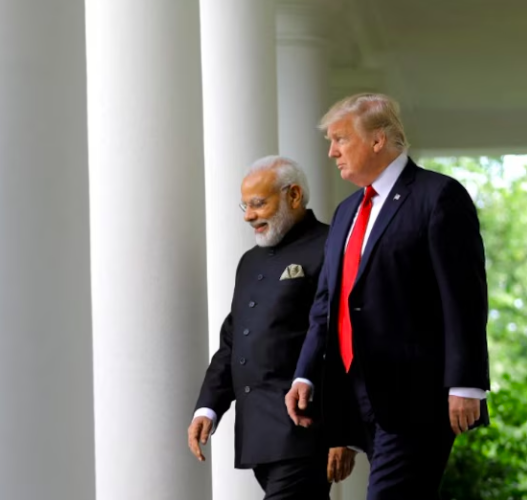
In a major development for India-US trade, former Foreign Secretary and Rajya Sabha member Harsh Vardhan Shringla spoke about the economic implications of the 50 per cent tariffs ordered by the United States under President Donald Trump. At an event in Virginia, Shringla pointed out that India is working assiduously to counter the effects of these blanket duties and seeking alternative markets for its exports.
“From tonight midnight, we will be on the receiving end of 50 per cent customs tariffs for products exported to the United States from India,” Shringla mentioned, emphasizing how severe the tariffs are. The tariffs are majorly impositioned on labour-intensive sectors such as agriculture, seafood, textiles, gems, diamonds, machinery, and handicrafts. They constitute a major share of India’s export to the US, making the tariffs a big challenge for exporters and firms in the country.
In spite of the possible jolt, Shringla was guardedly optimistic, highlighting India’s policy to cut dependence on the US market and diversify export destinations. “One of them is to look for alternative markets. We have Free Trade Agreements with Australia, the UAE, and the UK, and we are near finalizing a Free Trade Agreement with the European Union. That is to say, we have access to other markets and can divert some of our exports in that direction,” he clarified.
The tariffs, which are the highest India has ever seen from the US, impact almost two-thirds of Indian commerce with America. The sectors most at risk are textiles and garments, gems, diamonds and jewelry, machinery and appliances, agriculture and processed foods, metals, organic chemicals, shrimp and seafood, and handicrafts, carpets, leather, and furniture. Experts have cautioned that the short-term effects would be job losses in labor-intensive industries, higher prices for exporters, and possible changes in trade patterns.
Shringla’s comments follow what most analysts characterize as a volatile period in India-US economic ties. The former diplomat tried, however, to comfort businesses and stakeholders that the overall bilateral relationship continues to be robust. “We have the most comprehensive, multi-faceted relationship with the United States, the one that we have more than any other country,” he stated, referencing decades of co-operation in trade, defence, technology, and strategic areas.
He also welcomed the recent elevation of Sergio Gor as India’s Ambassador to the US, terming it a “positive step” which would further intensify diplomatic interaction and ease trade negotiations. Shringla hoped that a Free Trade Agreement with the US that would be beneficial to both sides could be finalized as soon as possible, saying that negotiations and high-level talks were underway.
The erstwhile Secretary also pointed to personal chemistry between President Trump and Prime Minister Narendra Modi as an element crucial in maintaining robust bilateral relations. “That bond doesn’t happen overnight. It happens from President Trump’s first term of office when you had events like Howdy Modi and Namaste Trump,” he said. These big-ticket summits, he added, highlighted the long-term strategic and economic relationship between the two countries even as trade tensions escalate.
While Trump’s tariffs are bound to have short-term effects on exporters, economists say that India’s proactivity in finding alternative markets could dull some of the sting. Expanding trade partnerships, joining new Free Trade Agreements, and making optimal use of existing ones can allow Indian enterprises to offset losses in the medium term.
Industry bodies have already started evaluating the impact of the tariffs. The Confederation of Indian Industry (CII) and Federation of Indian Export Organisations (FIEO) are said to be approaching the government to determine the support mechanisms, possible compensation schemes, and competitiveness enhancement methods in other overseas markets. Experts forecast that industries like textiles, gems, and seafood might experience pressures on prices, and they may influence global supply chains and US import trends.
The 50 per cent tariffs are part of a larger protectionist trade policy of the Trump administration, which has already slapped tariffs on various nations in the name of correcting trade imbalances and safeguarding industries. For India, which has always tried to stay on good terms with the US in trade, these steps pose both an opportunity as well as a challenge. Whereas the direct economic hit might prove to be challenging, the incident highlights the need to reinforce India’s trade arrangements and seek new markets in Europe, the Middle East, and Asia.
Shringla’s assurances are designed to convey a specific message to Indian industry and global partners: India is committed to keeping strong trade relations with the US while proactively managing the effect of tariffs by diversifying and making strategic alliances. “We are working on reducing the impact,” he reaffirmed, underlining that forward-looking measures, not reactionism, are the core of India’s strategy.
As the tariffs begin to bite, the next few months will challenge the toughness of India’s export industries. The government’s actions to obtain alternative markets, maximize Free Trade Agreements, and maintain diplomatic contact with Washington will determine the shape of India’s trade environment. For exporters, investors, and policymakers, it will be a matter of walking a tightrope between short-term dislocation and long-term planning strategy to negotiate this unprecedented tariff environment.
Overall, while Trump’s 50 per cent tariffs are a major roadblock for India-US trade, Harsh Vardhan Shringla’s statement is an indication of a cautious and calculated response. Through market diversification, consolidating trade agreements, and using diplomatic rapport, India will seek to reduce the economic blow without damaging its vital relationship with the United States—a relationship that, though not without periodic friction, is one of the most all-encompassing and long-term partnerships in the world.



Leave a comment