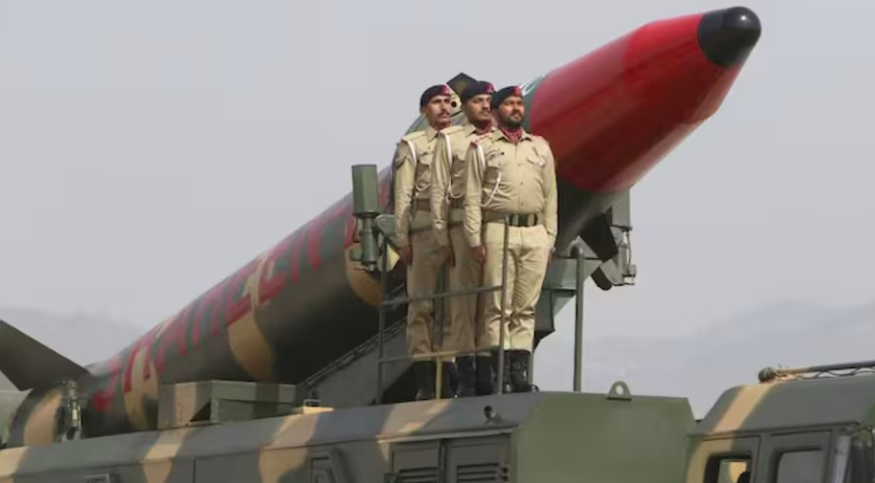
The CSIS report, drawing on defense satellite imagery, expert interviews, and leaked defense briefings, suggests Pakistan’s missile scientists, buoyed by sophisticated technology transfers, have moved beyond medium- and intermediate-range missile testing. The document specifically mentions the “Shaheen-III” missile series, with recent testing hinting at further range extensions exceeding 7,000 kilometers—the upper threshold for ICBMs as defined by international standards.
Dr. Lisa Curtis, former U.S. National Security Council official and South Asia analyst at the CSIS, warns, “This shift from regional deterrence to power projection on a global scale fundamentally alters the nuclear calculus not just for India, but for the United States and the broader international community.”
Inside Pakistan’s Strategic Motivations
Pakistan’s strategic community contends that the pursuit of an ICBM program is defensive in nature—primarily a response to India’s own Agni-V and Agni-VI missile projects and the emerging security architecture of the Indo-Pacific.
Speaking anonymously, a senior Pakistani official stated, “Pakistan does not seek arms parity with any global power, but neither can it ignore existential threats from advancing missile systems in its neighborhood. Our missile program serves as a deterrence, not as a first-strike tool.”
Still, the CSIS report cautions that the development of ICBMs by Pakistan would break long-understood regional deterrence frameworks, erasing the subcontinent’s traditional containment lines and potentially provoking a new arms race.
Broader Implications for Global Nonproliferation and US Policy
Washington’s reaction has been swift but measured, with senior administration officials reiterating calls for restraint. U.S. State Department spokesperson Matthew Miller told reporters, “We remain deeply concerned about the potential proliferation risks and urge all countries in the region to refrain from actions that could escalate tensions or undermine the global nonproliferation regime.”
Nuclear proliferation experts agree the situation could have far-reaching consequences. “If Pakistan operationalizes ICBM capabilities, it sends a signal to other regional rivals—especially Iran and North Korea—that ‘missile creep’ is tolerated by the international community,” warns Timothy Wright, research fellow at the International Institute for Strategic Studies (IISS).
Military analysts also point out that ICBMs, by design, allow a country to target adversaries far outside its own region. This heightens U.S. anxieties that destabilizing technology and know-how could proliferate to less predictable state or non-state actors.
India and Regional Response
India, Pakistan’s traditional rival, maintains its own ICBM project but has so far limited operational deployment. Indian defense spokespersons declined official comment, but retired Lt. Gen. D.S. Hooda remarked to The Hindu newspaper, “ICBM developments in Pakistan could prompt a reassessment of India’s nuclear posture. The risk of a destabilizing tit-for-tat missile race is very real.”
China, a close ally and defense partner to Pakistan, has not formally responded to the report. Beijing’s tacit support for Pakistan’s weapons technology in the past, however, is widely documented, complicating efforts for multinational arms control initiatives in the region.
Calls for Diplomacy and Next Steps
Leading arms control organizations urge the U.S. and the broader international community to engage Islamabad in diplomatic dialogue quickly. The Arms Control Association’s Daryl G. Kimball cautions, “Without transparency and dialogue between the U.S., Pakistan, and India, new missile developments could outpace diplomatic solutions, erasing decades of progress in nuclear risk reduction.”
U.S. lawmakers are reportedly considering new sanctions legislation targeting entities linked to Pakistan’s missile program. Meanwhile, the Biden administration faces pressure to address both the growing missile capabilities in South Asia and the risk of technology transfer to more problematic actors.