


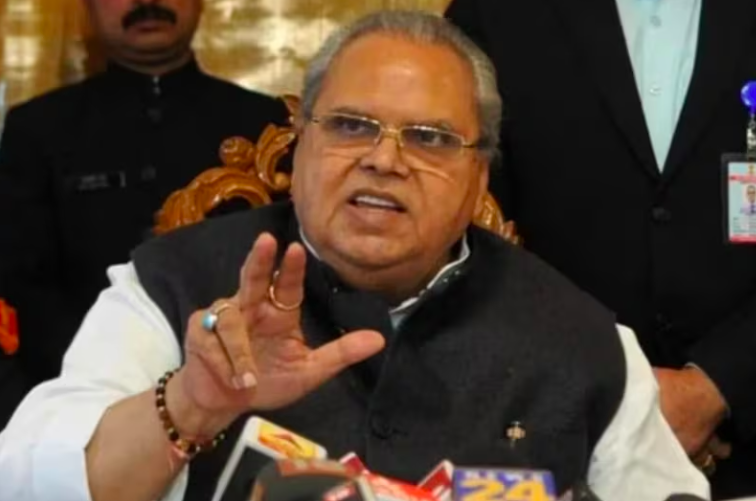
Satya Pal Malik, who was a seasoned politician, vocal public figure, and former Governor of Jammu and Kashmir, died on Tuesday at the age of 79. He passed away at Ram Manohar Lohia Hospital in New Delhi, where he had been under treatment for the last few weeks. His death concludes a long and eventful ride through Indian politics — one characterized by both controversy and conviction.
A Career Spent in Public Service
Satya Pal Malik was born in July 1946 at Hisawada village in the Baghpat district of Uttar Pradesh. His political consciousness was awakened during his student life. He was elected as the student union president at Meerut University in the academic session of 1968-69, which marked the beginning of a political career lasting more than five decades.
His electoral politics debut was made in 1974, when he was elected as a Member of Uttar Pradesh Legislative Assembly from Baghpat on the ticket of Charan Singh’s Bharatiya Kranti Dal. He continued to be active on the regional scene until he shifted to the national scene.
Malik’s stint in the Rajya Sabha between 1980 and 1989 gave him a wider platform to influence national policy. This was followed by a brief but significant career in the Lok Sabha when he represented Aligarh as a Janata Dal nominee in the 1989 general elections — a time of political turmoil and coalition governments in New Delhi.
During his political career, Malik earned a reputation for having changed sides ideologically — from regional party politics to national positions with the Janata Dal and finally the Bharatiya Janata Party (BJP), which he joined in 2004. By 2012, he had become the national vice-president of the BJP.
The Governor Who Spoke His Mind
While Malik had served in several roles during his lifetime, he entered gubernatorial fame only after joining the ranks of gubernatorial service. He was appointed Governor of Bihar in 2017 and soon gained fame not only for his administrative approach but also for making bold, frequently controversy-prone, public comments.
In 2018, he also briefly had additional charge as Governor of Odisha. But it was much later that year, in August 2018, when he became the Governor of Jammu and Kashmir — a role that would cement his legacy.
Malik was Governor of Jammu and Kashmir during a critical period in Indian history. On August 5, 2019, the central government revoked Article 370, which practically annulled the special status granted to the erstwhile state. It was one of the most sensational constitutional alterations post-independence. Malik had a pivotal administrative role to play as Governor during this volatile time, overseeing Jammu and Kashmir’s bifurcation into two Union Territories and the imposition of President’s Rule.
He was known for strong, if sometimes contentious, public statements during his time. While some admired him for being straightforward and available to the public, others criticized his bluntness as being incompatible with a gubernatorial office’s supposed apolitical character.
Having served in Jammu and Kashmir, he was sent to Goa in 2019 and remained there until 2020. During his brief but active tenure, he was back in the spotlight — this time for taking on the Goa state government over corruption charges in the procurement of COVID-19 relief supplies.
His last gubernatorial assignment was to Meghalaya, for which he was stationed between 2020 and 2022. Even there, Malik did not cease to hog the headlines for speaking out against alleged administrative slack, especially in matters of farmers’ concerns and national security. In a number of interviews following his retirement, he did not shy away from sharing his opinions on thorny subjects such as the farmers’ protests and national security mishaps — sometimes invoking curt denunciations from his former party members.
Legacy of an Unfiltered Voice
Satya Pal Malik never believed in mincing words. Whether as a student unionist, a politician in Parliament, or as a governor, he remained a persona who spoke truth to power without caring for the repercussions.
During the final years of his life, Malik turned into a sort of political rebel — an ex-BJP leader who didn’t shy away from attacking the centre on major issues. His open support for the farmers during the countrywide protests against the now-scrapped farm laws brought him both praise and condemnation. Though no longer serving in an official capacity, his interviews and public speeches frequently went viral for their acerbic analysis and blunt honesty.
Most across party lines recognized that even if they disagreed with Malik, they admired him for being willing to take a position. His detractors perceived him as too vocal, but his supporters perceived in him the rare virtue of integrity and independence in Indian public life.
Condolences Pour In
Following the news of his passing, tributes began to pour in from across party lines. Prime Minister Narendra Modi expressed his condolences on social media, writing, “Shri Satya Pal Malik Ji’s contributions to public life and governance will be remembered. My thoughts are with his family and admirers in this hour of grief.”
Congress leader Rahul Gandhi referred to him as “a rare politician who stood by the people, even when it meant going against the establishment.” A number of regional leaders also recognized Malik’s service to federal governance and his continued support of farmers’ rights.
Politicians from Jammu and Kashmir, especially, pondered his years in office during a time of upheaval in the state’s history. While his contribution to the abrogation of Article 370 remains under cloud, few will question that Malik’s legacy is forever linked to that fateful moment.
Final Rites and Public Mourning
Satya Pal Malik leaves behind his family, who have declared that his last rites will be performed in his home village in Baghpat, Uttar Pradesh. The central government declared a day of official mourning in his memory, with flags to fly at half-mast throughout Delhi and the Union Territories that he previously administered.
As the country says goodbye to a multifaceted, intriguing individual, one thing is certain — Satya Pal Malik’s legacy will be one that will be causing debate, introspection, and discussion for many years to come. In a world where political correctness is generally preferred over blunt talk, Malik was different because he was one who had no qualms about expressing himself as he saw it, no matter what.


