


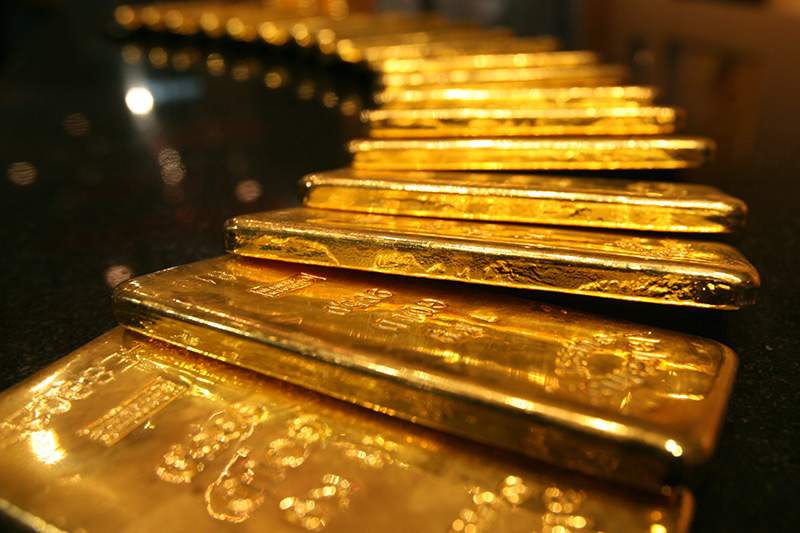
Gold prices remain near record high in the recent weeks as all these fears are being continued as investors are flowing into safe havens due to a prolonged US-China trade war. The market of bullions is further pushed up by geopolitical tensions, concern over inflation and softer dollar.
On Thursday, spot gold traded at a spot of $2,869.17 an ounce, little short of the record price of $2,882.53. Gold futures for April delivery fell 0.2% to a price of $2,887.90 an ounce. Futures notwithstanding, overall sentiment in the market is bullish as investors take shelter from economic uncertainties.
Gold Underpinned by Trade War Concerns
The gold price is said to be chiefly driven by the U.S.-China trade war. The latest raising of a 10% trade tariff by the U.S. on Chinese commodities has triggered retaliation from Beijing swiftly, and the market may soon be concerned that both economic behemoths are not going to settle down anytime soon. Market analysts at JPMorgan have cautioned that the trade war may go up in scale, thereby triggering higher tariffs, which would continue to support gold prices.
Traditionally, trade wars have triggered an increase in gold demand as people seek assets less exposed to currency devaluation or economic downturn. In the same breath, U.S. President Donald Trump’s recent statements regarding geopolitical matters, including a potential takeover of the Gaza Strip, have heightened uncertainty, raising demand for gold.
Effects of the U.S. Dollar and Interest Rates
Movement in the U.S. dollar has been another major factor that moves gold prices. Generally, a weak dollar allows gold to be attractive to foreign investors because it becomes cheaper in other currencies. This week, the dollar erased all of its gains for the week, and this, too, added to precious metal support.
Investors are closely monitoring the U.S. Federal Reserve moves on interest rates as well. Even as inflationary pressures stay at high levels, it is its interest rate adjustment strategy that will determine gold’s future course. Normally, higher interest rates have a negative impact as they make non-yielding assets like gold unappealing. In this economic uncertainty, however, demand has been resilient so far.
How Other Precious Metals Moved:
Gold’s surge has also supported other precious metals. Platinum futures increased 0.2 percent to $1,021.30 an ounce, while silver futures fell 0.8 percent to $32.708 an ounce. Silver, which has fallen just 0.8 percent today, has otherwise risen sharply over the past couple of weeks.
Investors are also looking ahead to economic data, particularly the United States nonfarm payrolls. Stronger employment numbers will send the greenback upward and increase pressure on the price of metals, whereas weaker employment data may make gold more attractive.
Copper Prices Rise on Relief from Tariffs and Hopes of Stimulus from China
Copper prices have surged in the industrial metals sector. Market sentiment improved after the Trump administration decided to delay imposing tariffs on imports from Canada and Mexico. This move provided relief to industrial metals traders and signaled a potential easing of trade tensions in North America.
The notions of expectations of economic stimulus measures have also been supporting the price of copper. The world’s largest consumer of copper is China. As far as its economic policies are concerning, it dominates the global demand for copper. On Thursday, benchmark copper futures on the London Metal Exchange rose by 0.8% to $9,341.70 per ton while March copper futures climbing 1.4% over three months. It became over $4.4985 per pound.

Investor Sentiment and Market Outlook
The sustained market rally in gold and industrial metals underlines how fragile the global economic landscape is. Investors are still monitoring geopolitical events, trade policies, and economic indicators for any indication of a potential market movement.
Going forward, if the trade tensions increase more, perhaps breaking past their records, then the gold prices may break past their record highs. On the other hand, a trade conflict resolution with an increased dollar may cap gold’s short-term gains.
For now, gold continues to be a first choice for risk-averse investors looking to protect themselves against the vagaries of the economy. Market analysts caution investors to stay abreast of key economic events and then act accordingly with their portfolios.
FAQs
Why are gold prices at near-record highs?
Gold prices are near record highs because of the persistent trade tensions between the U.S. and China, geopolitical uncertainty, a weaker dollar, and the inflationary worries that have forced investors into safe-haven assets.
How does the trade war impact gold prices?
The U.S.-China trade war increases economic uncertainty, prompting investors to seek refuge in gold. Tariff escalations and retaliatory measures can further drive up demand for the precious metal.
Will gold prices continue to rise?
While gold prices may fluctuate, continued economic uncertainties, high inflation, and global geopolitical tensions suggest that gold could see further gains in the near future.
How does the interest rate influence the gold price?
Normally, higher interest rates reduce the attractiveness of gold since it earns no interest. However, in case inflation continues to be high or economic uncertainty prevails, gold may continue to attract investors even at a higher interest rate.
What else affects the gold price?
In addition to trade wars and interest rates, gold prices are influenced by the U.S. dollar’s strength, central bank policies, global economic conditions, and investor sentiment toward riskier assets.


